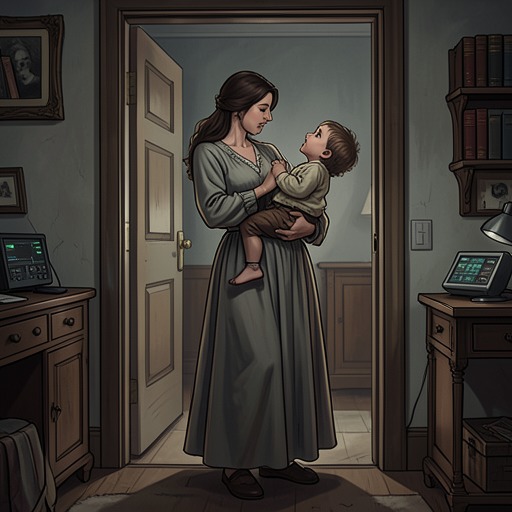
Kitty is left at the Treetops doorstep and taken in
Mothering SundayKitty’s arrival at Treetops Children’s Home turns an apparently empty doorstep into another test of the refuge’s promise: even when space is short, Sunday Small will not turn an abandoned baby away. A cry first mistaken for wind leads Sunday to a tightly wrapped infant, a letter, and the decision to make room for a child whose family has left her in the care of strangers.
The Cry at the Door
The discovery begins with uncertainty. A maid, Em’ly, insists that she has heard something, while Sunday wonders whether the sound is only wind moving through an old, draughty house. Sunday ventures onto the top step to reassure her, but, unable to hear anything herself, is about to go back inside when she notices a small bundle against one of the tall stone pillars. The delay between the reported cry and the sight of the baby makes the discovery a quiet reversal: what seemed like an ordinary disturbance proves to be a child deliberately left outside.
Sunday lifts the bundle and carries it into the warm hallway while Em’ly shuts the door against the cold. The contrast between the exposed doorstep and the protected interior gives the act of taking the baby inside immediate practical meaning. Tom Branning arrives asking where his wife is, with dinner waiting to be served, and finds Sunday holding the bundle close. When he draws the blanket aside, both of them see the baby’s deep brown eyes and realize that the bundle is an infant.
A Child Left in Trust
The letter makes clear that the child has been left intentionally and that her arrival is not the first such discovery at the home. Its unidentified writer says the baby was born the previous day, gives her name as Katherine, and asks Sunday and Tom to provide the safe refuge they already offer to children unable to live with their families. The writer also encloses money for the near future and promises further payments at regular intervals. Tom finds a wad of banknotes in the envelope; the note therefore brings both a request for care and material provision for it, though it does not identify the person who sent either.
Sunday looks back at the infant and chooses a more familiar name: she will call her Kitty. The baby’s dark hair lies around her head, and Sunday regards her as exceptionally beautiful. The naming makes the child more than the subject of the letter’s formal request: Katherine is welcomed into the household as Kitty, a particular baby whom Sunday has already taken into her arms.
Making Room at Treetops
Em’ly voices the immediate difficulty: there is no room for another child. Cissie Jenkins, who is in charge of the babies’ nursery, arrives shortly afterward, heavily pregnant with her third child and tired from climbing the stairs. She, too, initially reacts to the prospect of another infant with resignation. Her response is not to deny the shortage but to consider how the baby might be accommodated: Kitty can sleep temporarily at the bottom of another baby’s cot until her husband, George, fits an extra cot in the nursery.
Sunday confirms that they will keep the child, explaining that she cannot be turned away. Cissie accepts the decision and approves of Katherine as a straightforward name; when she leans over the baby, she also remarks on her prettiness. The exchange brings the decision down to the practical scale of beds, space, and the people who will provide care. The promise of money in the letter helps address Kitty’s needs, but it is the household’s willingness to rearrange its nursery that makes her immediate welcome possible.
The Home’s Continuing Work
The arrival is familiar enough for Sunday to call the baby another one: abandoned infants have already been left on the steps of Treetops Children’s Home. Yet familiarity does not make this child’s arrival routine or diminish the choice involved. The house is crowded, and Em’ly’s concern is real; still, Sunday’s refusal to send Kitty away renews the home’s defining commitment to children who cannot live with their own families.
As Cissie carries Kitty upstairs to the nursery, Sunday calls after her that she will come to help once dinner is over. Cissie tells her to take her time, and Sunday watches them disappear from view. The scene ends not with the arrival of a solution to the home’s space problem, but with the baby being carried toward the other children and the work of care continuing. Cissie’s light reference to the saying that Monday’s child is fair of face links Kitty’s appearance to the circumstances of her birth without altering the central fact of the episode: she has been left at the door, and the household has chosen to receive her.